




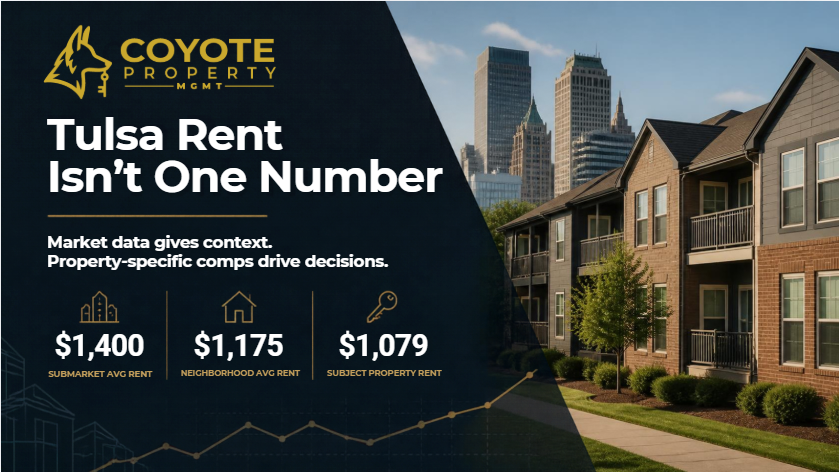
What Is the Average Rent in Tulsa? Why the Answer Depends on the Property
If you ask what the average rent is in Tulsa right now, you can get several different answers.
As of September 2026, Zillow’s rental-market page reports an average rent of approximately $1,400 across bedrooms and property types.
Zumper reports a Tulsa median rent of approximately $1,175.
Apartment List reports an overall median of approximately $1,079.
Those numbers are different enough that a rental-property owner could reasonably wonder which one is “right.”
The better question may be: What exactly is each number measuring—and how relevant is it to my property?
For rental owners and real-estate investors, citywide statistics can provide useful market context. But determining how to position an individual rental requires a more property-specific view.
Why Tulsa Rent Reports Can Show Different Numbers
Rental-market reports are not necessarily measuring identical things.
Sources may differ in the listings they observe, the property types included, the geographic boundaries used, how they calculate averages or medians, and the methodology used to account for changes in available inventory.
There is also an important distinction between an average and a median.
An average adds the observed rents together and divides by the number of observations. Higher-priced properties can pull that number upward.
A median identifies the midpoint of the observations.
Neither statistic is inherently better in every situation. They simply describe a dataset differently.
That is why owners should be careful about taking one citywide number and applying it directly to one rental property.
Your Rental Does Not Compete With Every Property in Tulsa
Consider a three-bedroom single-family rental in South Tulsa.
Its prospective renter probably isn't deciding between that property and every apartment, condo, townhouse and luxury rental across the city.
The real competitive set is narrower.
A useful rental analysis may consider properties with similar:
Location
A comparable rental should generally reflect the area in which a prospective resident is actually searching.
School districts, commute patterns, neighborhood characteristics and proximity to amenities can all influence the renter's alternatives.
Property Type and Size
A two-bedroom apartment and a three-bedroom detached house may both appear in citywide rental data, but they are not necessarily meaningful competitors.
Bedroom count, bathroom count, square footage, garage space and yard characteristics can change the competitive set considerably.
Condition
Two houses with similar floor plans can compete differently if one has recently updated flooring, paint, appliances or major systems while the other shows significant wear.
Condition affects both renter perception and how a property compares with alternatives.
Amenities
Garages, fenced yards, in-unit laundry, storage, updated kitchens and other features can influence positioning.
The question isn't simply whether an amenity exists.
It is whether renters comparing similar properties value it.
Timing
Rental markets are not static.
A property becoming available today may face a different competitive environment from the same property leasing several months from now.
Lease timing should therefore be part of the discussion rather than an afterthought.
Asking Rent Isn't the Whole Story Either
Even direct comparable listings require interpretation.
Suppose several similar rentals are listed at $1,700.
That doesn't automatically establish $1,700 as the market rent.
How long have those properties been available?
Have their asking rents changed?
Are they offering concessions?
What condition are they in?
Are prospective renters actually choosing them?
An asking price shows what an owner hopes to receive. It does not, by itself, prove what the market will ultimately support.
This is one reason rental pricing should be treated as an operating decision rather than simply a search for the highest available comp.
The Cost of Getting the Decision Wrong
An owner naturally wants to maximize rental income.
But asking rent is only one component of the property's financial performance.
An aggressive asking price that materially extends vacancy can create a different financial result than a slightly lower rent that produces a qualified tenant sooner.
On the other hand, consistently pricing below appropriate market levels can also affect long-term performance.
The goal is not automatically to charge the highest rent or the lowest rent.
The goal is to make an informed decision based on the property, current competition, owner objectives and market conditions.
Think Like an Asset Manager
At Coyote Property Management, we believe rental-property decisions should go beyond asking whether rent can be increased.
The property is an asset.
That means rent positioning should be considered alongside operating expenses, maintenance history, property condition, tenant experience, upcoming capital needs and the owner's longer-term strategy.
Citywide market data belongs in that conversation.
It simply shouldn't be the entire conversation.
A Tulsa rental report can tell you something about Tulsa.
A thoughtful rental analysis should tell you something about your property.
If you own rental property in Tulsa, Broken Arrow, Jenks, Bixby, Owasso or the surrounding area and you're evaluating rent positioning, a lease renewal, an upcoming vacancy or a potential investment, talk with Coyote Property Management.
Whether or not you ultimately need professional management, we're happy to look at the property, discuss the market and offer another perspective.